A High Platelet Count (Thrombocytosis): Causes, Symptoms & Treatment Optionsigh platelet count can sometimes be discovered unexpectedly during a routine blood test. Although an elevated platelet count does not always indicate a serious health problem, persistent elevation may require medical evaluation to identify the underlying cause.
Platelets are important blood components that help control bleeding and support normal blood clotting. When the platelet count becomes higher than expected, the condition is known as thrombocytosis. It may occur because of infections, inflammation, iron deficiency, blood loss, surgery, certain cancers, or disorders affecting the bone marrow.
Understanding the causes, symptoms, diagnosis, possible complications, and treatment options can help patients understand when specialist evaluation may be necessary.
What Are Platelets?
Platelets are small blood components produced primarily in the bone marrow. They circulate through the bloodstream and play an important role in controlling bleeding.
When a blood vessel is damaged, platelets gather around the injured area and contribute to the formation of a blood clot. This helps prevent excessive blood loss.
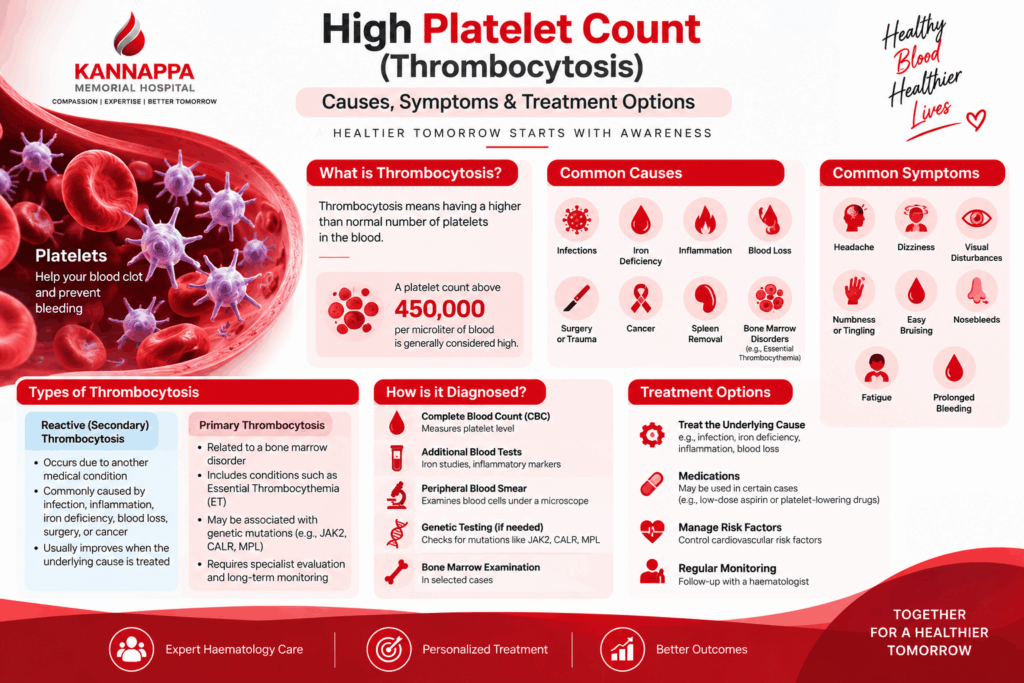
A high platelet count is generally described as a platelet level above 450,000 platelets per microliter of blood, although laboratory reference ranges may vary slightly.
A single abnormal blood test does not necessarily mean that a person has a serious blood disorder. Doctors usually consider the platelet level along with other blood counts, symptoms, medical history, and previous test results.
For evaluation of blood and bone marrow disorders, patients can explore Hematology Treatment in Chennai at Kannappa Memorial Hospital.
What Is Thrombocytosis?
Thrombocytosis means that the number of platelets in the blood is higher than expected.
There are two broad categories:
- Secondary or reactive thrombocytosis
- Primary thrombocytosis
Reactive thrombocytosis occurs when another condition causes the body to produce more platelets. Primary thrombocytosis is associated with abnormal blood-cell production within the bone marrow.
A high platelet count caused by a temporary condition may return toward normal after the underlying problem is treated. Persistent or unexplained elevation, however, may require further investigation by a haematologist.
Causes of High Platelet Count
There are several possible causes of thrombocytosis. Identifying the underlying cause is important because treatment depends largely on why the platelet level is elevated.
1. Infections
Bacterial, viral, or other infections can trigger inflammation and temporarily increase platelet production. Platelet levels may remain elevated during the recovery period and gradually return toward normal as the infection improves.
2. Iron Deficiency
Iron deficiency is a recognised cause of reactive thrombocytosis. This is one reason doctors may recommend iron studies when investigating persistently elevated platelet levels.
If iron deficiency is identified, treating the underlying deficiency may help improve the platelet count.
3. Inflammation
Chronic inflammatory conditions can stimulate increased platelet production. Conditions associated with inflammation may therefore contribute to thrombocytosis.
4. Blood Loss
Significant blood loss can cause the body to increase platelet production. Identifying and treating the source of blood loss is important, particularly when iron deficiency is also present.
5. Surgery or Trauma
Platelet levels may temporarily increase following surgery, significant injury, or other forms of physical stress. This type of elevation may improve during recovery.
6. Cancer
Some cancers may be associated with reactive thrombocytosis. If the platelet elevation remains unexplained or persistent, doctors may consider the patient’s overall clinical condition and determine whether additional investigation is required.
7. Spleen Removal
The spleen normally stores and helps clear some circulating platelets. Following spleen removal, platelet levels can increase because platelet distribution and clearance are changed.
Primary Thrombocytosis and Essential Thrombocythemia
In some patients, thrombocytosis is related to a disorder affecting blood-cell production in the bone marrow.
Essential thrombocythemia (ET) is a chronic myeloproliferative neoplasm in which abnormal blood-forming cells produce excessive numbers of platelets.
Certain acquired genetic mutations, including changes involving JAK2, CALR, and MPL, are associated with essential thrombocythemia.
However, having elevated platelets does not automatically mean that a person has essential thrombocythemia. Doctors generally need to exclude reactive causes and perform appropriate investigations before making a diagnosis.
Symptoms of High Platelet Count
Many people with thrombocytosis have no symptoms. The condition may be discovered when a complete blood count (CBC) is performed for another reason.
When symptoms occur, they may be associated with abnormal circulation, clotting, or bleeding.
Possible symptoms include:
- Headaches
- Dizziness or light-headedness
- Visual disturbances
- Numbness or tingling
- Burning or painful sensations in the hands or feet
- Chest discomfort
- Weakness or fatigue
- Easy bruising
- Nosebleeds
- Bleeding gums
- Prolonged bleeding after minor injuries
These symptoms are not specific to thrombocytosis and can occur with many other conditions. A doctor should therefore interpret symptoms together with blood test results and the patient’s overall health.
Can High Platelets Cause Blood Clots?
In certain forms of thrombocytosis, particularly some bone marrow disorders, abnormal clot formation can occur.
Possible complications may include:
Stroke
A blood clot affecting circulation to the brain can result in a stroke. Sudden weakness, facial drooping, difficulty speaking, or sudden visual problems require urgent medical attention.
Heart Attack
A clot affecting blood flow to the heart can cause a heart attack. Symptoms may include chest pressure or pain, sweating, nausea, and shortness of breath.
Deep Vein Thrombosis
A deep vein thrombosis (DVT) is a blood clot that commonly develops in a deep vein of the leg. Swelling, pain, warmth, or redness in the affected limb may occur.
Pulmonary Embolism
A clot can sometimes travel to the lungs and cause a pulmonary embolism. Sudden breathlessness, chest pain, rapid heartbeat, or coughing up blood requires urgent medical assessment.
Patients with concerns about clotting and bleeding can learn more about Hemostasis and Thrombosis Care at Kannappa Memorial Hospital.
Can High Platelets Cause Bleeding?
It may seem unusual that having too many platelets could be associated with bleeding, but bleeding can occur in certain situations.
In essential thrombocythemia, particularly when platelet levels become extremely high, platelet function may become abnormal. Very high platelet levels can sometimes be associated with abnormalities involving von Willebrand factor, which may increase bleeding risk.
Possible bleeding symptoms include:
- Nosebleeds
- Bleeding gums
- Easy bruising
- Prolonged bleeding from cuts
- Gastrointestinal bleeding
Therefore, the platelet number alone does not always determine whether a patient will experience clotting or bleeding.
How Is a High Platelet Count Diagnosed?
The first step in evaluating a high platelet count is usually a complete blood count (CBC).
Doctors may review:
- Previous CBC results
- Red blood cell counts
- White blood cell counts
- Peripheral blood smear
- Iron studies
- Signs of infection
- Signs of inflammation
- Medical history
- Medication history
- History of bleeding or clotting
- Previous surgery
- History of spleen removal
If the platelet level remains elevated without an obvious reactive cause, additional haematological evaluation may be required.
Depending on the clinical situation, doctors may recommend molecular testing for mutations such as JAK2, CALR, or MPL and, in selected cases, a bone marrow examination.
Kannappa Memorial Hospital’s Laboratory Services & Diagnostics information includes CBC, peripheral smear, bone marrow examination, coagulation testing, and molecular diagnostics.
Treatment for High Platelet Count
Treatment depends on the cause of thrombocytosis.
Treatment of Reactive Thrombocytosis
When the platelet elevation is reactive, treatment generally focuses on the underlying condition.
For example:
- Infection may require appropriate treatment.
- Iron deficiency may require iron replacement.
- Inflammatory conditions may require appropriate management.
- Blood loss requires identification and treatment of the source.
- Post-surgical elevation may settle during recovery.
In many cases, platelet-lowering medication is not required when reactive thrombocytosis improves after the underlying condition is treated.
Treatment of Essential Thrombocythemia
Treatment for essential thrombocythemia is individualized according to factors such as age, previous clotting events, cardiovascular risk, symptoms, mutation status, and overall risk.
Depending on the patient’s circumstances, management may include:
- Regular monitoring
- Low-dose aspirin in selected patients
- Medicines that reduce blood-cell production
- Management of cardiovascular risk factors
- Treatment of complications
- Specialist haematology follow-up
Patients should not start aspirin or other medicines simply because their platelet count is elevated. Treatment decisions should be made by a doctor after determining the underlying cause.
When Should You See a Doctor for High Platelets?
A mildly elevated platelet count may not represent an emergency, but persistent abnormalities should not automatically be ignored.
Medical evaluation is particularly important when:
- The platelet count remains elevated on repeated tests
- There is no obvious infection or inflammatory cause
- Iron deficiency is suspected
- There is a history of blood clots
- Unexplained bleeding or bruising occurs
- Persistent headaches or visual symptoms develop
- Other blood-count abnormalities are present
- The platelet count is extremely high
Sudden chest pain, severe breathlessness, sudden weakness, difficulty speaking, or symptoms suggesting a stroke, heart attack, or pulmonary embolism require urgent medical attention.
Why Specialist Evaluation Matters
A high platelet count can have many different causes, ranging from temporary infections and iron deficiency to chronic inflammatory conditions and bone marrow disorders.
A haematologist can review the complete blood count, compare previous results, assess symptoms, identify possible causes, and determine whether additional investigations are required.
Kannappa Memorial Hospital provides specialized Haematology Care in Chennai for blood disorders and conditions affecting blood cells and bone marrow.
Specialist assessment is particularly useful when platelet elevation is persistent, unexplained, or associated with other abnormalities.
High Platelet Count: Key Points to Remember
A high platelet count does not automatically mean cancer or a serious bone marrow disease.
In many patients, thrombocytosis is reactive and develops because the body is responding to another condition such as infection, inflammation, iron deficiency, blood loss, surgery, or another medical problem.
However, persistent unexplained thrombocytosis may require further evaluation because conditions such as essential thrombocythemia can cause sustained platelet elevation.
The most important step is to determine why the platelet count is high, rather than simply focusing on reducing the number.
Conclusion
A high platelet count or thrombocytosis means that the number of circulating platelets is above the expected range. It can occur because of infections, inflammation, iron deficiency, blood loss, surgery, cancer, or disorders affecting blood-cell production.
Many cases are temporary and improve when the underlying cause is treated. However, persistent or unexplained thrombocytosis requires appropriate medical evaluation.
If you have repeatedly elevated platelet levels, unexplained bruising or bleeding, persistent headaches, visual changes, or a history of abnormal clotting, consult a haematologist for appropriate assessment.
For specialized evaluation of blood disorders and platelet abnormalities, patients can consult the haematology team at Kannappa Memorial Hospital.